We offer lawn restoration across the whole of Todmorden, including Eastwood, Lydgate and Cornholme, as well as nearby Hebden Bridge, Bacup and Littleborough. Every job starts with a free site visit in Todmorden, where we measure up, check access and talk through options before sending a written quote.
Most tired lawns do not need replacing. They need the thatch and moss removed, the soil opened up so air and water get in, fresh seed where it has thinned, and a dressing to even out the surface. Todmorden Landscaping & Driveways offers lawn restoration across Todmorden using four treatments, aeration, scarifying, overseeding and top dressing, which we combine into a programme suited to what your lawn actually needs.
The service is for lawns that are more moss than grass by March, that go brown and hard in July, that squelch in winter or have bare patches where the dog runs. It is for homeowners who would rather spend a fraction of the cost of a new lawn and keep the one they have, and for people who have tried a bag of feed-and-weed and found the moss came straight back.
Restoration works with the seasons. Spring and early autumn are when the grass recovers fastest, so that is when we do the heavier work. Where a lawn is beyond saving, we will say so and point you to our New Lawn Installation service; where it just needs keeping on top of afterwards, Lawn Maintenance takes over. This page covers each treatment in detail and what affects the cost in Todmorden.
Lawn Aeration
Aeration means making holes in the lawn to relieve compaction and let air, water and nutrients down to the roots. It is the right choice for lawns that hold puddles after rain, that feel hard underfoot in summer, that have moss in the shady, trodden areas, or that sit on heavy clay. Any lawn that gets walked on compacts over time, and the roots end up living in the top 25 mm because they cannot push deeper.
We use two methods. Hollow-tine aeration pulls out plugs of soil about 12 mm wide and 75 to 100 mm deep, leaving holes that stay open and cores on the surface that break down or are raked off. It is the more effective treatment for compacted clay soils. Solid-tine spiking simply pushes a tine in, which helps surface drainage and is gentler on a fine lawn, but removes no soil.
Autumn is the best time, when the soil is moist and the grass is still growing, with spring second. We do not aerate in a dry summer, because the tines will not go into baked clay, nor in a frozen winter. After hollow-tining we often brush a sandy top dressing into the holes, which keeps them open for years rather than months.
The result depends on tine depth, hole spacing and soil moisture on the day. A compacted lawn usually needs hollow-tining every autumn for two or three years before it recovers, then every two to three years to keep it that way.
Lawn Scarifying
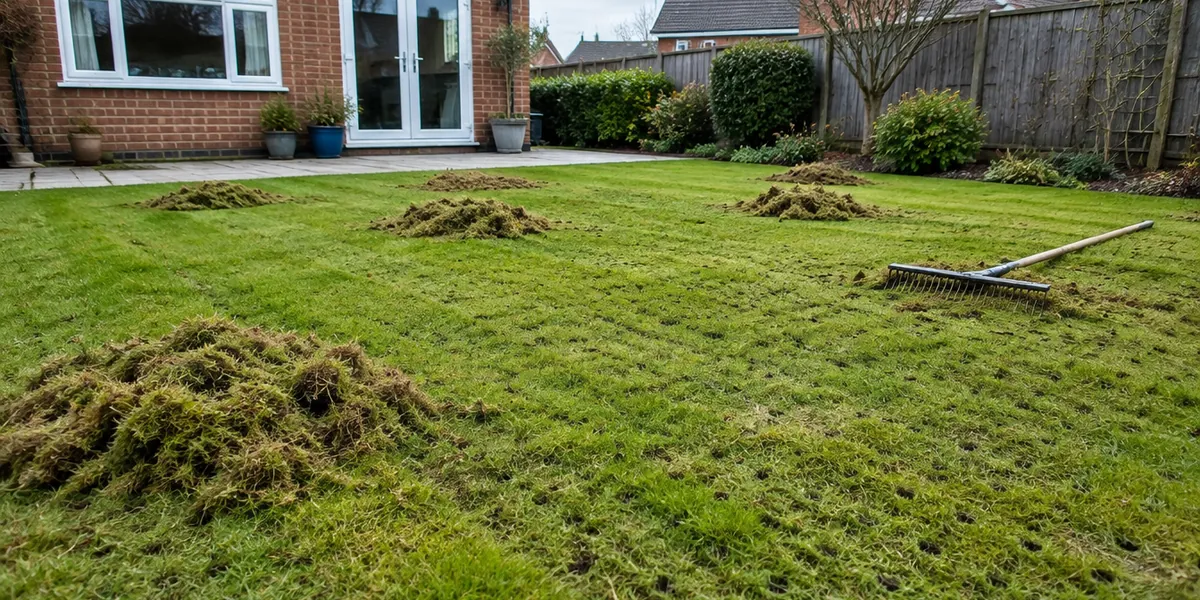
Scarifying is raking out the layer of thatch, moss and dead grass that builds up between the soil and the green leaf. Thatch deeper than about 10 mm stops water and feed reaching the roots, holds moisture that encourages moss and disease, and makes the lawn spongy. Scarifying is the right choice when a lawn feels soft, when moss has taken over, or when the grass looks thin and yellow even though it is being fed.
We use a petrol scarifier with fixed steel blades that cut vertically into the sward and lift the debris out, going over a badly thatched lawn in two directions. The amount that comes out surprises most people in Todmorden: a dozen bags from an average back garden is not unusual. The lawn looks worse immediately afterwards, with bare soil showing, and that is normal.
Timing is everything. Early autumn, from late August to early October, is ideal because the grass has the warmth and moisture to recover before winter. A lighter pass in April is possible once growth has started. We do not scarify in summer or winter, and we apply a moss killer two weeks before where moss is heavy, so it is dead and lifts out rather than spreading.
Scarifying is nearly always followed by overseeding and often by top dressing, because the gaps will fill with weeds and moss again if they are not filled with grass. The result depends on blade depth, set to scratch the soil surface without tearing out the good grass, and on what is done in the fortnight afterwards.
Lawn Overseeding
Overseeding is sowing new grass seed into an existing lawn to thicken it, fill bare patches and introduce better grass varieties. It is the right choice after scarifying or aeration when the sward has been opened up, for lawns that have thinned under trees or from heavy use, and for patches worn by children, dogs or a paddling pool. It is also how we improve a lawn laid with a cheap seed mix, by bringing in finer or more hard-wearing varieties over a couple of seasons.
Seed needs to touch soil to germinate, so the lawn is scarified or at least raked hard first, and bare patches are loosened with a fork. We sow at around 25 to 35 grams per square metre, lower than for a new lawn, choosing a mix to suit the site: ryegrass and fescue for wear, fine fescue and bent for an ornamental finish, shade mixes under trees, and drought-tolerant blends for dry, sunny lawns in Todmorden.
After sowing we lightly rake, roll or tread the seed in and apply a top dressing or a thin layer of compost on bare areas to keep it damp and hide it from birds. The lawn is watered if the weather is dry and kept off for a couple of weeks. Germination takes one to three weeks in the autumn and spring windows.
Mowing resumes once the new grass reaches 50 to 75 mm, with the blades high and sharp. The result depends on seed-to-soil contact, moisture and timing. Overseeding in summer heat or winter cold wastes seed, so we schedule it with the autumn and spring restoration visits.
Lawn Top Dressing
Top dressing is spreading a thin layer of sandy loam, or a sand and compost mix, over the lawn and working it into the surface. It evens out hollows and bumps, improves the soil structure over time, helps seed establish and, after hollow-tine aeration, fills the holes with free-draining material so they keep working. It is the right choice for lawns that are uneven to mow, on heavy soil, or being overseeded after scarifying.
We use a screened 70/30 sand and soil mix for most Todmorden lawns, or a sandier mix on heavy clay where drainage is the problem. It goes on at about 2 to 4 kilograms per square metre, a layer a few millimetres thick: enough to settle into the sward but not enough to smother the grass. Hollows are filled a little at a time over two or three seasons rather than buried under a thick layer that kills the grass beneath.
The dressing is spread with a shovel and worked in with a lute, the back of a rake or a drag mat until the grass tips show through evenly. It is done on a dry day, on a lawn that has just been mown and ideally scarified or aerated, so the material has somewhere to go. Autumn is the main window, with spring second.
Top dressing is slow, physical work and the treatment people most often skip, but it is what turns a scarified, seeded lawn into a level, firm, well-drained one. The result depends on a consistent screened material, applied thinly and worked in properly rather than left sitting on the surface.
Why Choose Us for Lawn Restoration in Todmorden
Restoring a lawn is a programme, not a single visit, and the order and timing of the treatments matter more than any one of them. We look at the lawn, dig a small test hole to see the thatch depth and the soil, and tell you which of the four treatments it needs, in what order, and when. Sometimes that is a full autumn programme; sometimes it is just hollow-tining and a dressing.
Our team uses professional machines, a pedestrian hollow-tine aerator, a fixed-blade scarifier and a proper spreader, which do in an hour what a hired electric raker will not do in a day. We choose seed and dressing to suit the soil and shade in your Todmorden garden, not a one-size bag from the garden centre.
We tell you honestly when a lawn is not worth restoring and a new lawn would be cheaper in the long run. Everything we remove, including the bags of thatch and moss, leaves with us as registered waste carriers. You get a written quote for the programme and a written guarantee on the work we do.
Our Lawn Restoration Process
- Assessment: we walk the lawn, check thatch depth and soil with a test hole, look at drainage, shade and wear, and identify moss, weeds and any pests or disease.
- Programme and quote: you get a written plan setting out which treatments are needed, in what order and in which season, with a price for each.
- Pre-treatment: where moss is heavy we apply a moss killer around two weeks before scarifying, and the lawn is mown short the day before we start.
- Scarifying: thatch and dead moss are raked out mechanically, in two directions if needed, and bagged and removed.
- Aeration: the lawn is hollow-tined or spiked, with cores raked off or left to break down.
- Overseeding and top dressing: seed is sown into the opened sward, dressing is spread and worked in, and the lawn is rolled or trodden to firm it.
- Aftercare: we leave written instructions for watering, keeping off and the first cut, and can return for a follow-up feed and check.
A full autumn programme on an average Todmorden lawn is usually done in a single day, with the lawn looking rough for two to three weeks and much improved by the following spring.
How Lawn Restoration Is Priced in Todmorden
The size of the lawn and which treatments it needs are the main factors. A lawn that only wants aerating is a quick visit; a full programme of scarifying, aerating, overseeding and top dressing takes the best part of a day and uses a lot of material. Top dressing in particular scales with area, because a few millimetres over a large lawn is several tonnes of sand and loam.
Condition matters. A heavily thatched or mossy lawn in Todmorden produces far more waste to bag and remove, and may need two passes with the scarifier. Compacted clay takes longer to hollow-tine than light soil. Bad hollows need several seasons of dressing rather than one.
Access affects how we get machines and tonne bags of dressing into the back garden. Seed choice shifts the price a little, with shade and fine mixes costing more than standard ones. Moss treatment, feeding and follow-up visits are itemised separately, and we will always suggest the minimum programme that will work rather than the maximum we could sell.
Lawn Restoration Across Todmorden
We restore lawns in every part of Todmorden, and the problems vary from garden to garden. In Walsden, if your garden is shaded and enclosed, the problem is usually moss and thatch, which scarifying and a shade seed mix sort out. If your lawn in Cornholme or Eastwood is on heavy ground, it calls for hollow-tine aeration and sandy top dressing year on year. In Lydgate, if your lawn is newer, it may be compacted from the build, and if you have a larger lawn in Shade, a full autumn programme gives the biggest improvement. Wherever you are in Todmorden or nearby Hebden Bridge, Bacup and Littleborough, the assessment is free.
Related services we offer across Todmorden include lawn services.
Frequently Asked Questions
Can my mossy lawn be saved or does it need replacing?
Most can be saved. If there is still a reasonable amount of grass between the moss, scarifying out the moss, aerating, overseeding and dressing will bring it back over a season. If the lawn is over three-quarters moss or weed, or sits on rubble, a new lawn is usually cheaper. We tell you which after a quick look.
When is the best time to scarify a lawn in Todmorden?
Early autumn, from late August to early October, is best because the grass has warm soil and reliable rain to recover before winter. A lighter scarify in April works once growth has started. Never scarify in summer drought or winter cold, as the grass cannot regrow and weeds take the gaps.
Will the lawn look worse after restoration?
Yes, for two to three weeks. Scarifying leaves bare soil showing and top dressing looks like a layer of sand over the grass. That is normal. New seed comes through within a fortnight in the right season, and by six weeks the lawn is thicker and greener than before. By the following spring the difference is obvious.
How often does a lawn need aerating?
A compacted or clay lawn in Todmorden benefits from hollow-tine aeration every autumn for two or three years, then every two to three years to maintain it. Lighter soils and lawns with little foot traffic need it less often. Solid-tine spiking can be done more frequently as a gentler option.
Can I walk on the lawn after overseeding and top dressing?
Keep off it as much as possible for about two weeks so the seed is not disturbed and the dressing settles. Light foot traffic is fine after that. Hold off mowing until the new grass reaches 50 to 75 mm, then cut high with sharp blades. Keep the lawn watered if the weather turns dry during germination.