Homeowners across Todmorden use us for gravel driveway repair, from Eastwood and Shade out to Walsden and nearby Hebden Bridge, Bacup and Littleborough. We check the base and the drainage on every Todmorden drive we price, because the surface is rarely the whole story.
A gravel drive is cheap to lay and easy to live with, right up until it starts to develop holes, ruts and bare patches. Todmorden Landscaping & Driveways provides gravel driveway repair for homes across Todmorden, from small front gardens with a loose shingle surface to long private drives. The service covers pothole filling, rut repair and the rebuilding of drives where rain has washed the gravel away, and it is for anyone whose gravel drive has stopped being a pleasure and started being a nuisance.
Nearly every gravel drive problem in Todmorden comes down to the same thing: gravel laid straight onto soil, or onto too thin a base, with nothing to hold it in place. The stone sinks into the ground, cars push it into ruts and every heavy shower carries some of it onto the pavement. Topping up with another tonne of shingle hides the problem for a few months and no more.
Our repairs put a proper structure under the gravel: a compacted Type 1 MOT base, a geotextile membrane, edging to keep the stone in and sometimes a plastic grid to lock it down. The gravel on top is then just a surface finish, which is what it should be.
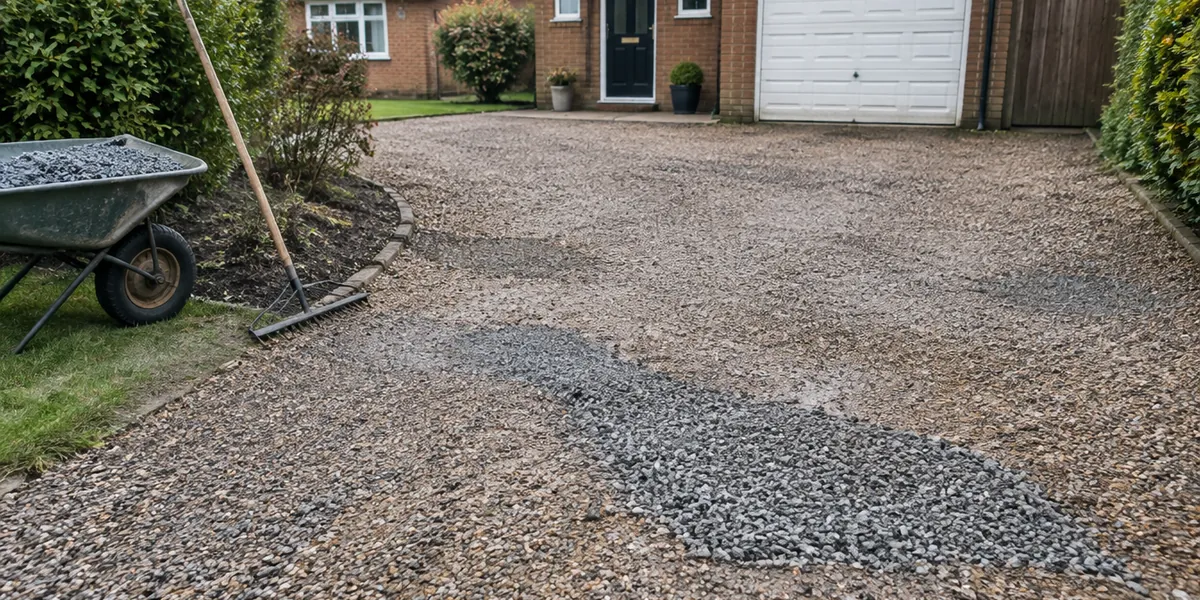
Gravel Driveway Pothole Repair
Potholes in gravel drives form where water pools and where car wheels stop and turn, which is often the same spot. The surface stone gets pushed sideways, the base underneath softens, and each time a car drives through the puddle it pumps out a bit more material. Left alone, a pothole on a Todmorden gravel drive grows every winter.
Shovelling fresh gravel into the hole does not work for long, because the gravel just sinks into the soft base. We dig the hole out to firm ground, which is often deeper than the hole looks from the surface, and remove any wet, muddy material. If there is no membrane, we lay a piece of geotextile across the base of the hole to stop the new stone disappearing into the soil.
The hole is then filled with Type 1 MOT in layers of around 75 mm, each compacted with a vibrating plate until it is solid. We bring the base up to about 30 to 40 mm below the finished level, then top with gravel to match the rest of the drive, raking it level and compacting it again.
If the pothole is in a spot where water collects, filling it alone will not stop it coming back. We look at the falls across the drive and may add a soakaway, a French drain or a channel to get the water away before it has a chance to do more damage.
Gravel Driveway Rut Repair
Ruts are the twin tracks that form where car tyres run along the same line every day. Over time the stone is pushed out to the sides and into the middle strip, leaving two grooves that fill with water and mud. On older gravel drives around Todmorden they are a sign that the base is absent or too thin to spread the wheel load.
For shallow ruts on a drive with a reasonable base, the fix is to rake the displaced gravel back from the ridges into the ruts, loosen the compacted stone with a landscape rake or tine harrow, re-grade the whole surface to a slight camber and compact it. We top up with fresh gravel to replace what has been lost.
Deep ruts mean the base has failed. We scrape the loose gravel aside and keep it for reuse, excavate the rutted strips, lay membrane and build the base back up with compacted Type 1 MOT. The most reliable way to stop ruts returning on a drive that gets daily car use is to install a gravel stabilisation grid: interlocking plastic honeycomb panels laid on the base and filled with angular gravel. The grid stops the stone moving sideways, so the tyre tracks never form.
Gravel choice makes a difference to rut repair. Rounded pea shingle rolls under tyres and ruts quickly; angular crushed stone such as 20 mm granite or limestone locks together and holds its shape far better. We can advise on the right stone when we visit.
Gravel Driveway Washout Repair
Washout is what happens on sloping gravel drives, or drives that take run-off from a roof or a neighbouring surface, after heavy rain. The water picks up the smaller stones and carries them to the bottom of the slope, onto the public footway or into a drain. What is left behind is a channel of bare base or mud. With wetter winters it is a problem we see more often than we used to.
Repairing a washout means dealing with the water first. We look at where it comes from, which is usually a downpipe discharging onto the drive, a patio draining towards it or simply the slope of the ground. The fix might be a channel drain at the top of the slope, a French drain along one side or a soakaway at the low point. Where the drive meets the road we often install a channel to stop gravel washing onto the highway.
With the drainage sorted, we rebuild the washed-out section. The channel is cleared of silt, the base is rebuilt with compacted Type 1 MOT, a membrane is laid and the surface is regravelled. On slopes we almost always recommend a stabilisation grid, because loose gravel on an incline will keep moving no matter how well it is laid.
A timber, metal or concrete edge along the low side of the drive stops stone escaping, and it is often the single most effective part of the repair.
Why Todmorden Homeowners Choose Us for Gravel Driveway Repair
Gravel is often treated as the DIY option. Where we add value is in the structure: the base, membrane, edging, grids and drainage that turn a gravel drive from a yearly chore into a surface that behaves itself. Todmorden Landscaping & Driveways has repaired and rebuilt gravel drives across Todmorden for years and we know what works on local ground.
We quote in writing and we do not oversell. If a drive just needs re-grading and a tonne of stone, that is what we quote for. If it needs a grid and a drain, we explain why. Our structural repairs come with a written guarantee and we are insured and registered to carry waste.
If you are weighing up whether to keep a gravel drive at all, we also build block paving, tarmac and resin-bound drives and can give you a like-for-like comparison.
Gravel Driveway Repair: Step by Step
- Survey: we assess the depth of the gravel, probe for a base and membrane, check the falls and trace where the water comes from.
- Written quote: an itemised quote covering base repairs, drainage, edging, any grid system and the stone we will use.
- Scrape and save: sound gravel is scraped aside and kept for reuse so you only buy what is needed to make up the shortfall.
- Excavation: potholes, ruts and washed-out channels are dug out to firm ground and silt removed.
- Base and membrane: geotextile is laid and Type 1 MOT built up in compacted layers to the right depth.
- Drainage and edging: channels, soakaways and edge restraints are installed where they are needed to keep water and stone where they belong.
- Surfacing: grids are fitted if specified, gravel is spread, raked to a camber and compacted, and the drive is ready to use straight away.
Most gravel repairs in Todmorden are finished in a day or two. The best time is late spring to early autumn when the ground is dry enough to compact well, though we work through most of the year.
How Gravel Driveway Repair Is Priced in Todmorden
The condition of the base decides most of the cost. If there is a firm base already, repairs are largely a matter of labour and a little stone. If the gravel is sitting on soil, we are effectively building a drive from scratch in the damaged areas, and the quantity of Type 1 MOT and the skip loads of spoil add up.
Drainage is the next factor. A simple regrade needs none, while a washout on a slope might need a channel drain, a soakaway and edging before any gravel goes down. Stabilisation grids add to the material cost but save on future repairs.
The type of gravel matters as well: a local crushed limestone is cheaper than a decorative Scottish granite or a flint shingle. Access in Todmorden and the length of the drive both affect labour and delivery, and whether we can reuse your existing stone or need to replace it all plays a part too.
Gravel Driveway Repair Throughout Todmorden
We repair gravel drives in all parts of Todmorden. If you have a longer gravel drive in Walsden, we repair the ruts and potholes it develops, while in Cornholme and Lydgate we often sort out small gravelled front gardens where stone keeps spilling onto the pavement. If your plot in Eastwood slopes, washout and drainage repairs are the usual fix, and in Shade we have installed a good number of stabilisation grids. If you live in another part of Todmorden or in nearby Hebden Bridge, Bacup and Littleborough, we are glad to come out and take a look.
People in Todmorden often ask us about concrete driveway repair and tarmac driveway repair at the same time.
Frequently Asked Questions
Why does my gravel driveway keep getting potholes?
Potholes keep coming back when gravel has been laid on soil or on too thin a base, so wheel loads push the stone into the ground and water softens the spot further. Topping up the hole with more gravel does not address this. The lasting repair is to dig the hole out, lay a membrane and compacted Type 1 MOT and only then replace the gravel.
How deep should the gravel be on a driveway?
For a drive taking cars the surface gravel should be around 30 to 50 mm deep over a compacted base of at least 100 to 150 mm of Type 1 MOT. Much deeper gravel is actually worse, because it moves under tyres and ruts quickly. If you are using a stabilisation grid the gravel sits within the grid cells plus a thin dressing on top.
Can you stop gravel washing onto the pavement?
Yes. The usual answer is a combination of edging across the entrance, a channel drain or gravel trench to catch water before it reaches the road, and a stabilisation grid on the first few metres where the slope is steepest. On flat drives in Todmorden a simple edge restraint and a slightly dished entrance is often enough.
Is a gravel grid worth the money?
On a drive that gets daily car use, on a slope, or where ruts have formed before, a grid pays for itself by stopping the stone moving and cutting the amount of raking and topping up you do. On a flat drive used by one car with a good base it is less necessary. We will tell you honestly which applies to your drive.
Does a gravel driveway need planning permission?
Gravel is a permeable surface, so laying or repairing a gravel drive in your front garden does not need planning permission under the 5 m² rule that applies to impermeable surfaces. If you want a dropped kerb to the road that is a separate application to the council's highways department. Conservation area rules may apply to the type of stone in some places.