Homeowners across Todmorden use us for concrete driveway installation, from Shade and Eastwood out to Cornholme and nearby Hebden Bridge, Bacup and Littleborough. We design each new drive in Todmorden to drain properly within the front-garden permeable-surface rules, and help with any dropped kerb application to Calderdale Council.
A concrete driveway is one of the toughest surfaces you can put in front of a house, and Todmorden Landscaping & Driveways has been pouring them across Todmorden for homeowners who want hard standing that will not rut, sink or need weeding. This page covers the three finishes we offer, plain, pattern imprinted and exposed aggregate, and the ground work underneath that decides whether a slab lasts decades or cracks in its first winter. It is written for anyone in Todmorden weighing concrete against tarmac, block paving or resin for a new or widened drive.
Concrete suits a lot of Todmorden properties. It takes the weight of a van or a motorhome without marking, it can be poured to awkward shapes without cutting hundreds of blocks, and once sealed it is easy to keep clean. The trade-off is that a slab is not permeable, so drainage has to be designed in from the start.
We pour concrete ourselves rather than subcontracting the slab. The sub-base, mesh, joints, finish and drainage are one team's responsibility, and the written guarantee covers the whole thing.
Plain Concrete Driveways
A plain concrete driveway is a single poured slab with a brushed, tamped or power-floated finish. It is the most economical form of concrete driveway installation and the one we recommend for working drives in Todmorden, side returns, areas that will be partly hidden by a parked car, and anywhere the budget is better spent on depth than on decoration.
We lay a 100 mm slab for cars and 150 mm where a van or caravan will stand, using a C35 air-entrained ready-mix with 20 mm aggregate. Air entrainment matters in Todmorden winters because the tiny bubbles give freezing water somewhere to expand without spalling the surface. A142 or A193 steel mesh sits in the middle of the slab on chairs, not on the sub-base, so it actually does something when the ground moves.
The finish is chosen for grip. A stiff-brushed texture across the direction of travel gives the best footing in frost and hides minor blemishes. A tamped finish is coarser and suits a rural or farm-style drive. Power floating gives a smooth surface that looks sharp but gets slippery when wet, so we only use it on covered or sheltered areas. Control joints are cut at 3 to 4 m centres and at any change in width, and an expansion joint of compressible filler board separates the slab from the house wall and the garage floor. Left to cure under polythene for a week, a plain slab needs almost no maintenance beyond an occasional pressure wash.
Pattern Imprinted Concrete Driveways
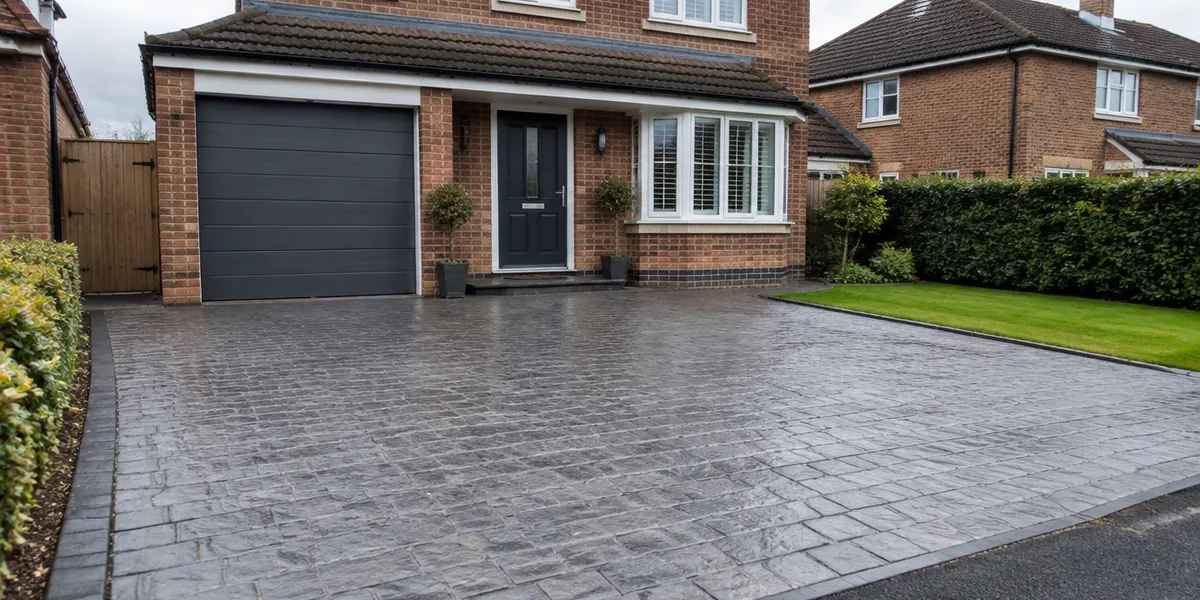
Pattern imprinted concrete gives you the look of cobbles, slate, Yorkstone flags or fan-laid setts in a single joint-free slab. We pour, colour and stamp the surface in one visit, so there are no gaps for weeds or ants, and the finished drive is sealed to bring out the colour and keep oil and tyre marks on the surface rather than in it. It is a popular choice in Todmorden for front gardens where the owner wants something more decorative than tarmac without the upkeep of real block paving.
The process is time-critical. Once the slab is poured and levelled we broadcast a colour surface hardener, trowel it in, apply a contrasting powder release agent and press rubber mats into the surface while the concrete is still plastic. The window is a couple of hours, so we only stamp in settled weather and size the pour to what the team can finish.
After a few days the surface is pressure washed to remove excess release agent, the joints are cut to follow the pattern lines, and two coats of acrylic sealer go on. The sealer keeps the colour bright and wants reapplying every few years. Imprinted concrete is not permeable, so on a Todmorden front garden we fit a linear drain at the threshold or fall the slab to a border. What affects the result most is the sub-base, the weather on the day and the care taken matching the mat pattern across the slab.
Exposed Aggregate Concrete Driveways
An exposed aggregate driveway shows the stone within the concrete rather than hiding it under a smooth cement skin. The finish is textured, slip-resistant in all weathers and very good at disguising tyre marks and the odd drip of oil, which is why we suggest it for sloping drives in Todmorden and for homeowners who like a natural, pebbly look without loose gravel.
We specify the mix around the stone you want to see. Decorative aggregates such as golden flint, rounded river pebbles, blue granite or black basalt are either batched into the whole mix or, more economically, seeded onto the surface of a standard slab straight after screeding and pressed in. A chemical surface retarder is then sprayed on, which stops the top couple of millimetres of cement paste from setting while the slab below cures normally.
The next morning the surface is pressure washed and brushed to strip away the paste and reveal the aggregate. Getting the exposure depth right, enough to show the stone but not so much that it loosens, depends on the retarder, temperature and timing. Once dry we apply a penetrating sealer that resists staining without a glossy look.
Underneath it is the same as a plain slab: 150 mm of compacted Type 1 MOT, mesh, 100 to 150 mm of air-entrained concrete, control joints and an expansion joint against the house. Exposed aggregate is not porous, so falls and drainage are designed with the same care as any other concrete driveway installation in Todmorden.
Why Todmorden Homeowners Choose Us for Concrete Driveway Installation
Concrete is unforgiving. A slab poured on soft ground, without mesh, with the joints in the wrong place or on a frosty morning will crack, and there is no cheap way to put that right. Our team has poured enough driveways around Todmorden to know what clay does in a wet winter, how much sub-base a given plot needs and when to call off a pour because the forecast has changed.
We use ready-mixed concrete from a plant with a documented mix design rather than site-batched concrete of uncertain strength, and we hold the delivery ticket for your records. Mesh is placed on chairs, joints are planned on a drawing before the pour, and curing is done properly under polythene rather than leaving the slab to dry out in the sun.
You get a written quote with the slab depth, mix and finish spelled out, a written guarantee on the work, waste removed by a registered carrier and the same people on site from excavation to sealing. If tarmac driveway installation or block paving would serve your house better, we will tell you that too.
Our Concrete Driveway Installation Process
- Survey and levels. We measure the area, check the fall away from the damp-proof course and towards the drainage point, and locate any manholes, stop taps or tree roots in the way.
- Excavation. The ground is dug out to around 250 to 300 mm below the finished level, with the spoil removed by skip or grab lorry.
- Sub-base. A geotextile membrane goes down on clay ground, followed by 150 mm of Type 1 MOT compacted in two layers with a vibrating plate.
- Formwork and drainage. Timber forms or permanent edgings are set to the finished levels, and channel drains, gullies or a soakaway are installed before any concrete arrives.
- Mesh and pour. Steel mesh is set on chairs, the concrete is poured, vibrated and screeded to the falls, then finished by brushing, stamping or seeding aggregate as agreed.
- Joints and curing. Control joints are cut within 24 hours, the slab is covered to cure, and it is kept free of traffic for about a week.
- Sealing and handover. Decorative finishes are washed and sealed, the site is cleared, and we hand over a care sheet with the guarantee.
From first dig to parking on the drive, most concrete driveway installation jobs in Todmorden take about ten days, of which a week is simply waiting for the concrete to gain strength.
What Affects the Cost of Concrete Driveway Installation in Todmorden
The area of the driveway is the starting point, but it is rarely the whole story. The condition of the ground underneath matters a great deal: a Todmorden plot on soft clay or made ground needs a deeper sub-base and sometimes a membrane, while a site that has already had a drive on it may need less excavation.
The finish is the next biggest factor. A plain brushed slab is the most economical. Pattern imprinted and exposed aggregate add colour hardeners, release agents, retarders, decorative stone and sealers, plus extra labour on the day. Slab thickness for vans or motorhomes, the amount of steel reinforcement and the number of joints all move the price.
Access affects cost too. A drive the concrete lorry can discharge straight into is simpler than one that needs a pump or barrowing through a side gate. Add to that drainage requirements, the length of new edging or kerbing, a dropped kerb application, removal of an old surface and disposal of spoil, and you have the main elements of a concrete driveway quote in Todmorden.
Concrete Driveway Installation Throughout Todmorden
We pour concrete driveways throughout Todmorden. If your frontage in Walsden is narrow, a plain brushed slab makes the most of limited space, while a wider plot in Cornholme gives room for an exposed aggregate sweep with a turning area. Homeowners in Lydgate often ask for pattern imprinted concrete to replace a tired tarmac drive, and if your drive in Eastwood slopes, a textured finish is the safer choice. If you have a newer house in Shade with a single-width builder's drive, we can widen it for a second car. We also cover nearby Hebden Bridge, Bacup and Littleborough.
Related services we offer across Todmorden include driveway extensions and widening.
Your Questions Answered
How thick should a concrete driveway be?
For cars we pour 100 mm of concrete over 150 mm of compacted Type 1 sub-base. Where a van, caravan or motorhome will be parked we increase the slab to 150 mm and use heavier mesh. On soft ground in Todmorden we sometimes deepen the sub-base rather than the slab, because it is the ground that moves, not the concrete.
How long before I can drive on a new concrete driveway?
Keep off it entirely for the first 24 to 48 hours, walk on it after three days and park a car on it after seven days. Full strength takes around 28 days, so we ask you to avoid heavy vehicles, turning on the spot and skips for the first month. Cold weather slows curing, so winter pours need a little longer.
Will a concrete driveway crack?
All concrete shrinks slightly as it cures, which is why we cut control joints at regular intervals. These give the slab a planned place to crack cleanly along a straight line that you will barely notice. Random cracking usually comes from a poor sub-base, missing mesh or joints spaced too far apart, all of which we design out.
Is a concrete driveway permeable?
No, a standard slab is impermeable, so rainwater must be managed. On Todmorden front gardens that means falling the slab to a lawn or border, fitting a channel drain connected to a surface water drain or soakaway, or keeping the impermeable area under 5 m². We agree the drainage route before quoting so planning rules are met.
How do I look after pattern imprinted concrete?
Sweep it, wash it with a hose or a low-pressure wash and avoid de-icing salt in winter, which attacks the surface. The acrylic sealer that keeps the colour bright wears with traffic and sun, so plan to have it cleaned and resealed every few years. Minor scuffs from turning tyres blend in once the sealer is refreshed.