If you live in Cornholme, Eastwood or anywhere else in Todmorden, we can quote for driveway drainage installation; we also cover nearby Hebden Bridge, Bacup and Littleborough. We check the base and the drainage on every Todmorden drive we price, because the surface is rarely the whole story.
Where does the rain go when it lands on your driveway? If the answer is "towards the garage door", "into next door's garden" or "it just sits there", you need drainage. Todmorden Landscaping & Driveways installs channel drains, gullies and culverts on new and existing driveways across Todmorden. We do this work for homeowners building a new drive, for anyone whose current drive floods, and for people told by a planning officer or building inspector that run-off from their hard standing must be dealt with on their own land.
The rules are worth knowing. A new or replacement front-garden driveway over 5 square metres needs either a permeable surface or a way of directing water to a soakaway or planted area on the property, or it needs planning permission. Connecting driveway drainage to the public sewer without permission is not allowed. These are the sustainable drainage, or SuDS, principles, and they shape every installation we design.
Below we describe the three kinds of drain we fit, what we do on site and what affects the cost in Todmorden.
Where We Offer Channel Drain Installation
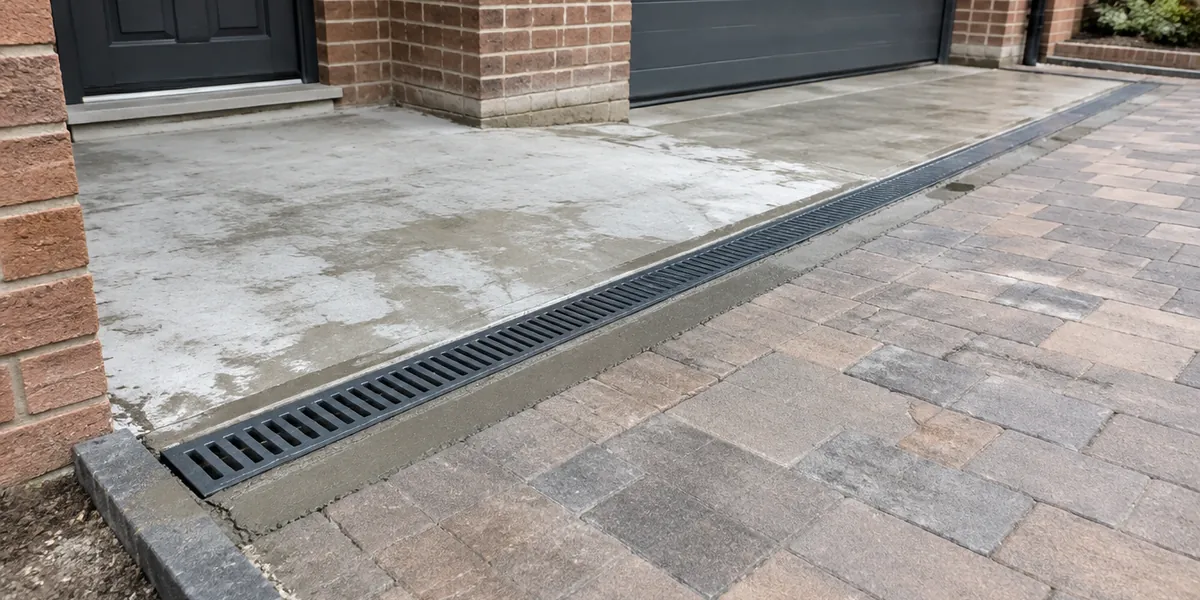
A channel drain, sometimes called a linear drain or by the trade name Aco, is a long, narrow trough with a grating on top that runs across the width of a driveway. It collects water flowing down a slope before it reaches a garage door or a wall and carries it to an outlet. On most drives in Todmorden it is the first thing we reach for when a drive slopes towards the house.
It is the right choice when water arrives in a sheet across a wide area rather than at one low point. Many building inspectors require one where a drive meets a garage door or a damp-proof course.
We install channel drains in a concrete haunch. The trench allows at least 100 millimetres of concrete under and either side of the channel, the units are set to a slight fall towards the outlet and the joints are sealed. The grating sits a few millimetres below the finished surface so water cannot bypass it. The outlet goes to a soakaway or a gully connected to an existing surface water drain. We use polymer concrete or heavy-duty plastic channels with gratings rated at least class B125, so a car can drive over them without cracking.
The fall across the drive, the length of channel needed, how deep we can go before hitting services and where the water can legally be sent all shape the result. A channel with nowhere to drain to is just a trough.
Driveway Gully Installation
A gully is a single point drain: a pot set into the drive with a grating on top and an outlet pipe below. It collects water from an area laid to fall towards it from all sides, rather than from a line like a channel drain. Most houses already have a gully or two taking the roof downpipes.
It is the right choice for a drive with a natural low point, for a parking area dished to a central point, and for taking the outlet from a channel drain into the pipework. A trapped gully, with a water seal in the pot, is the correct type where the pipe joins a combined sewer, because it stops smells.
We locate the existing surface water and foul drains first, because connecting surface water to the foul sewer is not permitted. The pot is set in concrete at the low point with the grating level with the finished surface, and the paving is laid to fall to it at around 1 in 60 to 1 in 80. The outlet is connected with 100 millimetre underground pipe to a soakaway or the surface water drain, laid on pea shingle at a fall of at least 1 in 100. A soakaway is sited at least 5 metres from the house.
Where the ground is heavy clay it drains slowly, so a soakaway may need to be larger or a piped outlet may be needed instead. We check with an infiltration test before committing to the design.
Driveway Culvert Installation
A culvert carries water underneath a driveway where the drive crosses a ditch, stream, swale or field drain. It is most common on rural and semi-rural drives, where a property is reached by crossing a roadside ditch. Without one, the drive acts as a dam and the water finds its own way over or under it.
It is the right choice when an existing watercourse or ditch must keep flowing, when a new access would otherwise block a field drain, and when the highways or lead local flood authority requires a crossing to be piped. A culvert in a watercourse usually needs consent, and we help with the application.
We use twin-wall plastic or concrete pipe sized for the flow, typically 300 millimetres or larger for a ditch crossing, laid on a granular bed with the invert matching the ditch bed at each end. The pipe is surrounded with compacted granular fill and covered with enough depth to carry vehicles before the drive surface goes over the top. Headwalls at each end, in concrete, brick or stone, stop the bank washing away and keep the pipe ends clear. A grating on the upstream end stops debris entering where there is a risk of blockage.
The size of the ditch, the flow after heavy rain, the depth of cover available and any consent conditions all shape the design. An undersized culvert is worse than none, so we size for storm flows rather than a dry summer day.
Why Choose Us for Driveway Drainage Installation in Todmorden
Drainage is the part of a driveway nobody sees and the part most often skipped. We fit it on every drive we build in Todmorden, and we retrofit it on drives built by others that have flooded since the day they were laid. Laying paving to the correct falls every week means we know where water will go before the first block is down.
We check where drains run before we dig, we never connect surface water to a foul sewer, and we design to SuDS principles so water soaks away on your land wherever the ground allows. Channels and gullies are set in concrete, not sand, so they stay put under a car.
Every installation comes with a written quote, a written guarantee and the cover of our insurance. Spoil goes under our waste carrier registration. If you later need Driveway Drainage Repair or routine maintenance, you are dealing with the people who fitted it.
Our Driveway Drainage Installation Process
- Site survey: we watch where water runs, measure the falls, identify the surface area draining and locate existing drains and services.
- Ground check: a simple infiltration test tells us whether a soakaway will work in your soil or whether we need a piped outlet.
- Design and quote: we choose channel, gully, culvert or a combination, size the pipework and soakaway, and set it out in a written quote.
- Consents: where a watercourse or sewer connection is involved we tell you what permission is needed and help obtain it.
- Excavation: trenches and pits are dug by mini digger or hand, keeping clear of services.
- Installation: drains are bedded in concrete or granular fill to the correct falls, pipes are laid and joints sealed.
- Reinstatement and test: the surface is made good, the system is flushed with a hose to check flow and you get a sketch of what was fitted and where.
A channel drain and soakaway on an existing drive in Todmorden is typically a two-day job. Drainage built into a new driveway is scheduled as part of the groundworks.
What Affects the Cost of Driveway Drainage Installation in Todmorden
The main driver is the length of drain and pipe run. A short channel across a garage threshold with a soakaway a few metres away is a small job; a long run to the far side of a garden, or a culvert across a wide ditch, is a different scale of excavation.
Ground conditions change the design. Clay soil may need a larger soakaway or a piped outlet instead. Rock, tree roots or shallow services slow the digging. Whether the drive surface is new or has to be cut, lifted and reinstated around the drain makes a large difference in labour.
The product chosen matters: a heavy-duty polymer concrete channel with a ductile iron grating costs more than a domestic plastic one, and we match the specification to the load. Consents for watercourse crossings, CCTV surveys to find existing drains and the disposal of spoil are listed separately on every written quote we give in Todmorden.
Driveway Drainage Installation Around Todmorden
We install driveway drainage throughout Todmorden and nearby Hebden Bridge, Bacup and Littleborough. If your drive in Walsden runs down to the garage door, a channel drain at the threshold is usually the answer, and it is the drain we fit most often. When a drive in Cornholme or Lydgate is being resurfaced, we fit gullies and soakaways to satisfy the permeable paving rules. If the infiltration test on your drive in Eastwood shows clay, a piped outlet often works better than a soakaway, and where a home in Shade is reached across a ditch, we build the culvert crossing. Anywhere in Todmorden, we will survey the drive and tell you what will actually work.
People in Todmorden often ask us about driveway drainage repair and driveway drainage maintenance at the same time.
Your Questions Answered
Do I need drainage for a new driveway in Todmorden?
If the drive is at the front, over 5 square metres and not permeable, yes: the water must be directed to a soakaway or planted area on your land, or you need planning permission. Even on a permeable or rear drive, a channel drain at a garage door or house threshold is sensible and often required by a building inspector.
Can driveway drainage connect to the existing drains?
It can connect to a surface water drain, never to the foul sewer. Many older houses have combined drains, in which case a trapped gully is needed and the water company may need to approve the connection. A soakaway on your own land avoids the issue where the soil allows it.
What is a soakaway and how big does it need to be?
A soakaway is a pit filled with gravel or plastic crates that lets water soak into the ground gradually. Its size depends on the area draining to it and how quickly your soil absorbs water, which we measure with an infiltration test. It should be at least 5 metres from the house and clear of other foundations.
Will a channel drain take the weight of a car?
Yes, if it is the right class and installed properly. We use channels and gratings rated at least B125 for domestic drives and set them in a concrete haunch rather than on sand. Where a van or motorhome is parked we specify a higher load class and a bolted grating.
Do I need permission to put a culvert in a ditch?
Usually. A culvert in a roadside ditch or watercourse normally needs consent from the lead local flood authority, the highways authority or the Environment Agency depending on the watercourse. We advise which applies to your property in Todmorden and help with the application before any digging starts.